Bright living room
CategoriesLighting

How to Choose Home Lighting Without Regrets: A 20-Year Expert Guide to Brighter, Safer Spaces

Building or remodeling your dream home is an exhilarating journey, but it is also a minefield of tiny decisions that can lead to long-term regrets. Among all the interior elements, lighting is the one thing that can single-handedly make a million-dollar renovation look cheap—or make a budget-friendly space look incredibly luxurious.

When you browse the market, thousands of beautiful fixtures look stunning in photos, but their price tags and descriptions vary wildly. How do you pick the absolute best options for your family? Over my 20 years in the home building materials industry, I have seen too many homeowners flush money down the drain on lighting that either burns out too quickly, flickers constantly, or causes severe eye strain.

Choosing the perfect house lights goes far beyond aesthetics and prices. You need to look under the hood at safety, light quality, durability, and how your family actually lives in each room. Let’s dive into a practical, jargon-free checklist to help you light your home flawlessly.

1. The Ultimate Eye-Protection and Safety Checklist

First things first: when it comes to electricity in your home, never gamble on safety to save a few bucks.

Look for Verified Safety Certifications

Before you fall in love with a lamp’s silhouette, check its backbone. Ensure the fixture has passed rigorous, mandatory national and international safety regulations—such as 3C, CE, or UL certifications. These badges guarantee that the internal wiring, insulation, and fire resistance have been tested under extreme conditions, keeping your house and family completely safe.

The Secret to True Visual Comfort

If you have ever felt an unexplainable headache after reading in your living room or noticed your kids rubbing their eyes during homework, your lights are likely the culprits. When picking home LEDs, remember these four golden metrics:

  • Flicker-Free Performance: Low-quality LED drivers produce an invisible, rapid strobe effect that triggers severe eye fatigue and migraines. Insist on high-quality, constant-current solid-state drivers that eliminate visual stroboscopic flicker entirely.
  • Color Rendering Index (Ra): Have you ever bought a beautiful rug or wallpaper, only for it to look dull, grayish, or muddy once installed under your ceiling lights? That is due to a low CRI. For a home where food looks delicious, clothes look vibrant, and textures pop, aim for Ra≥90 (where 100 Ra is natural sunlight). Your eyes will feel significantly less tired.
  • Color Temperature (K): Light color dictates mood. For daytime productivity, clean white light works well. But for cozy evenings in the bedroom or living room, stick to warmer tones between 2700K and 4000K to help your mind and body unwind before sleep.
  • The 45° Anti-Glare Rule: Recessed downlights and spotlights are modern essentials, but if you look up and get blinded by raw, piercing light, the geometry is wrong. Opt for fixtures with a deep-set baffle design and a shielding angle of 45° or greater. This ensures the light shoots down to illuminate your floors and art, hiding the raw bulb from your direct line of sight.

2. Advanced Material Science: Matching Fixtures to Your Life

A light fixture needs to survive the physical reality of your home—steam in the master bath, flying toys in the playroom, and years of daily cleaning. The longevity of your lighting depends entirely on the materials used for the housing and shades.

Navigating Shade Materials for Each Room

Different plastics, glasses, and metals behave differently under heat and humidity. Here is how to assign them properly across your floor plan:

SceneMaterialFeatures
Kitchen & Kids’ RoomsABS MaterialHigh Impact, Easy Clean
Living & Dining AreasAcrylic / MS / GlassSoft Glow, High Elegance
Bathrooms & OutdoorPVC / PCWaterproof, Anti-Corrosion
  • ABS Plastics: Known for incredible impact resistance and mechanical toughness. If a stray toy hits an ABS fixture in a child’s bedroom, it will bounce right off without shattering. It’s also incredibly easy to wipe down, making it perfect for oily kitchen environments.
  • Acrylic (PMMA) & MS Materials: These are the gold standards for generating a soft, luxurious ambient glow. Acrylic features phenomenal light transmission (>92%) and won’t turn into an ugly, brittle yellow after years of operating heat. MS offers a beautiful blend of acrylic-like clarity with superior scratch resistance.
  • PVC & Polycarbonate (PC): If you are outfitting a wet bathroom zone, a covered patio, or an outdoor walkway, you need weather-resistant materials. PVC and PC shades offer incredible moisture barrier properties and chemical resistance, locking out steam and water ingress.
  • Tempered Glass: Highly elegant and primarily used in premium decorative fixtures and statement chandeliers. It delivers peerless visual clarity but adds structural weight and demands careful handling.

Don’t Skip the Chassis: Aluminum vs. Plastic

LED chips generate massive internal heat. If a fixture uses a cheap plastic or flimsy iron casing, that heat gets trapped, causing the light to dim permanently within a year. Look for fixtures crafted with extruded aluminum alloy housings and integrated cooling fins. Aluminum draws heat away from the core electronics instantly, ensuring your investment lasts well over 50,000 hours.

3. The Layout Shift: Say Goodbye to the Dreaded “One Room, One Light”

For decades, the standard way to light a house was simple: slap a giant, flat ceiling panel or an ornate chandelier dead-center in the room and call it a day. The result? A harsh, sterile environment filled with deep, awkward shadows whenever you stand at the kitchen counter or look in the mirror.

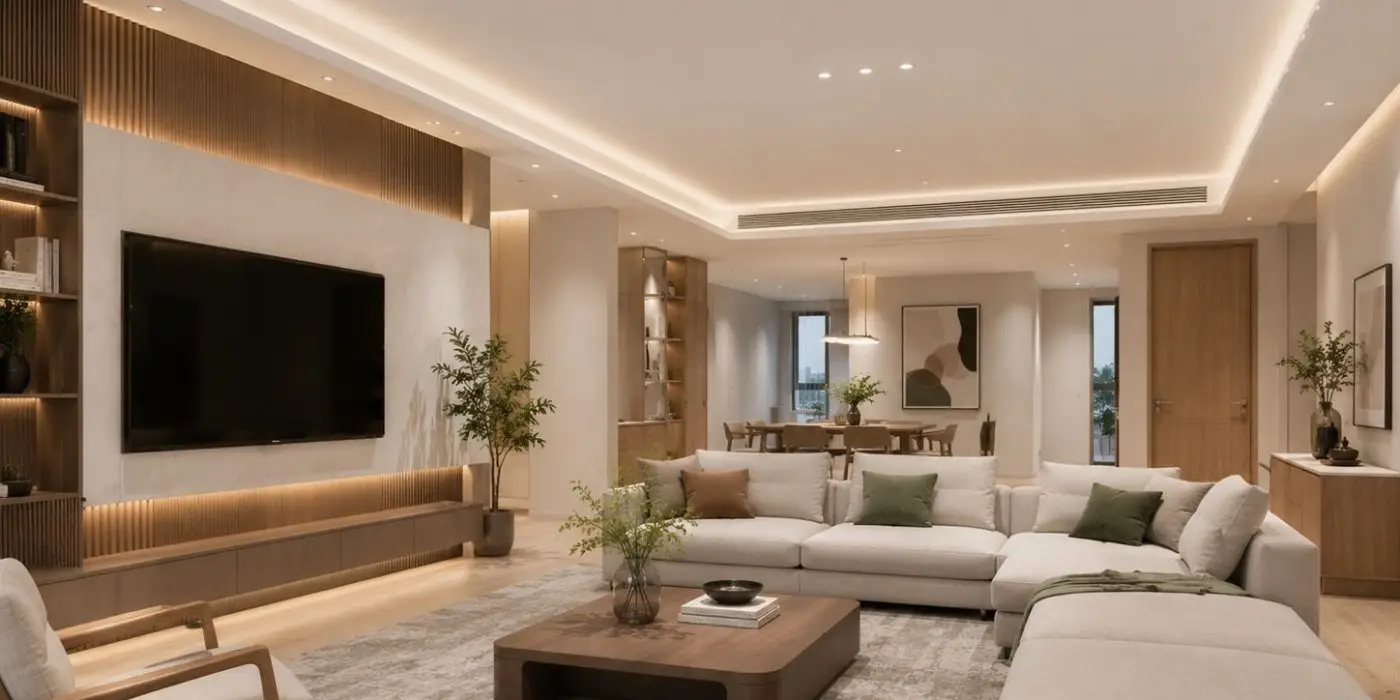
Today’s most comfortable homes rely on Mainless (Layered) Lighting Design. Instead of relying on one blinding central source, we place lights exactly where you need them, blending linear LED strips, low-profile downlights, adjustable spotlights, and decorative floor lamps.
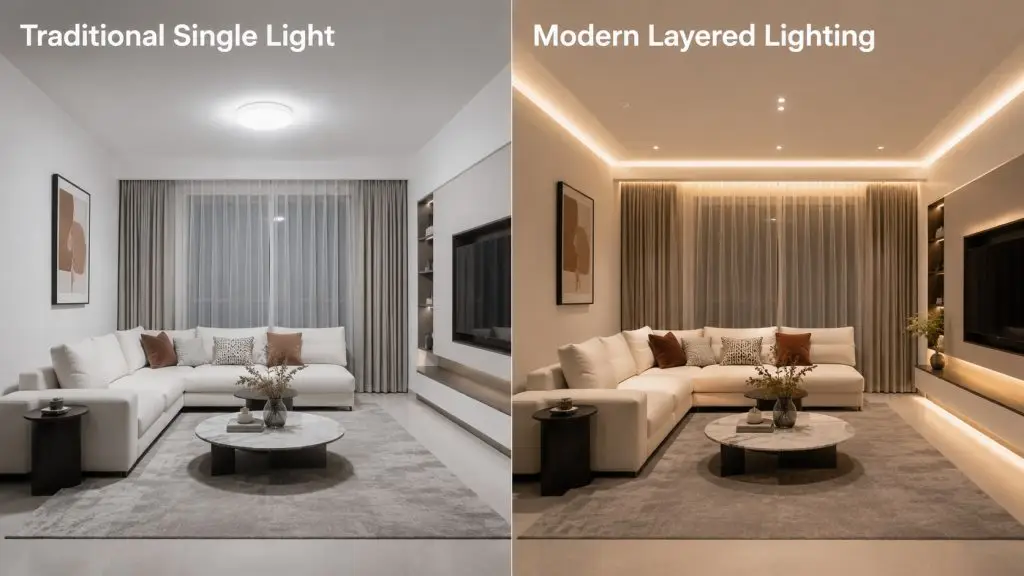
Comparison of two lamp layouts

Imagine a typical evening: someone is at the dining table reading, while another person is winding down on the couch to watch a movie. With a layered mainless setup, you can dim the living room spotlights and turn on a warm, hidden LED accent strip behind the TV console. The room feels cozy, and the light won’t wash out the screen or bother the eyes, yet the dining area remains perfectly lit. It’s all about creating zones that adapt to your family’s daily rhythms.

4. Smart Buying: Real-World Details Homeowners Often Miss

Before you click “buy” on a massive lighting order, take a breath and run through these real-world sanity checks that can save you a fortune in electrician fees and returns:

  • Ceiling Depth Clearness: Deep-cone, low-glare architectural downlights are gorgeous, but they require physical space inside your ceiling. Before purchasing, ask your contractor for the exact clearance height between your drywall ceiling and the concrete slab or structural wooden joists. Make sure the fixtures you order can fit into that gap without hitting HVAC ducts or wiring.
  • The Bug-Proof Shield: If you hate taking down ceiling fixtures every summer just to clean out a graveyard of dead bugs and dust, look for sealed IP40-rated chassis designs. These completely seal the internal housing, keeping the light pristine and maintenance-free for years.
  • Silent Smart Fan Lights: Combining a ceiling fan with an LED light is brilliant for saving space in bedrooms or nurseries. But cheap fan motors hum loudly, ruining a quiet night’s sleep. Look for models featuring brushless DC motors that operate at 32dB or lower (whisper-quiet) and feature smooth, multi-speed smart remotes.

5. Your Premium Home Lighting Partner: George Group

At the end of the day, turning your dream home design into a reality requires sourcing products from a name you can trust. Navigating international quality standards, verifying material safety, and finding highly customizable designs that match your unique taste is an exhausting process for any homeowner. That is where George Group steps in as your ultimate household solution.

As a premier destination for integrated home building materials and full-house customized solutions, George Group bridges the gap between commercial-grade manufacturing precision and personalized residential design. Whether you are seeking a complete set of ultra-high CRI, anti-glare downlights for a minimalist living room, or robust, water-resistant linear fixtures for a modern spa bathroom, our manufacturing ecosystem provides flawlessly matched, certified solutions. With pristine quality control, secure international home-delivery packaging, and premium materials, George Group ensures that the very first time you flip the switch, your new home shines exactly the way you envisioned.
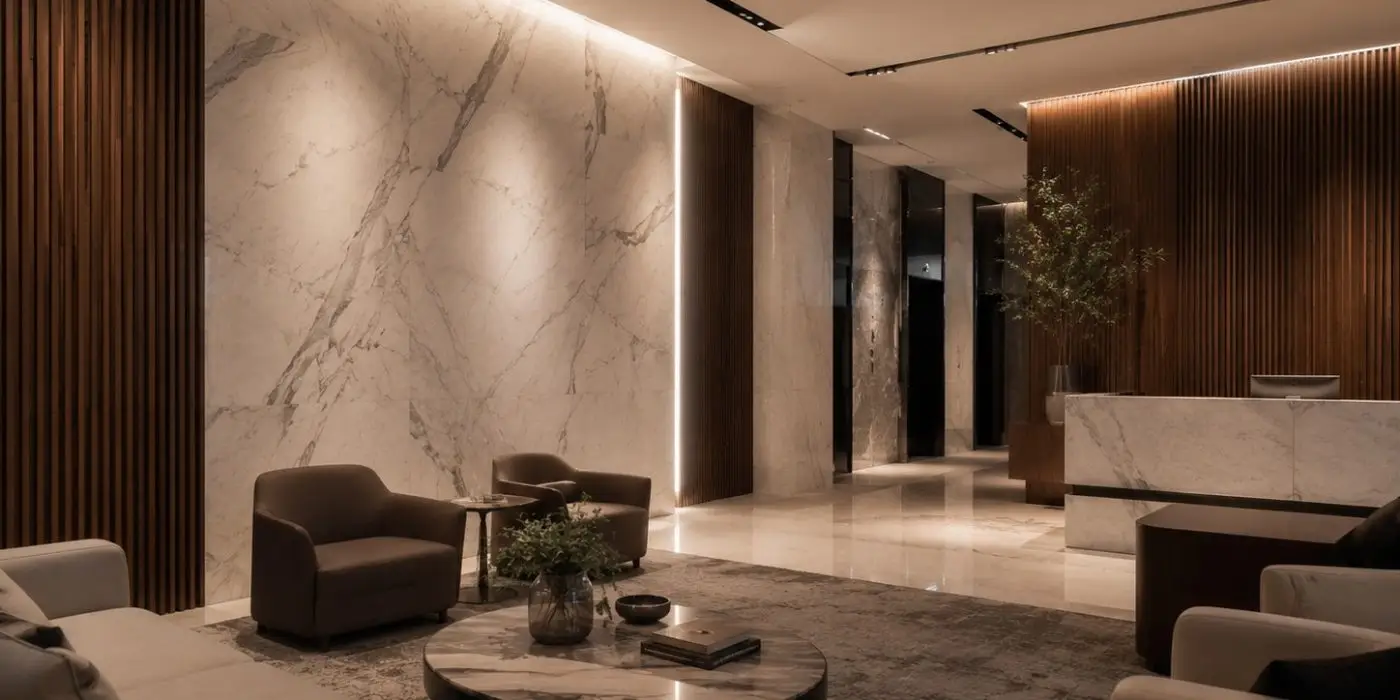
High-end architectural photography of a luxury modern commercial property lounge featuring multi-layered, glare-free recessed downlights and hidden linear LED strips illuminating premium marble walls and wood panels.
CategoriesLighting

4 Commercial Lighting Mistakes That Cost Developers Thousands During Project Handover

In large-scale commercial and multi-family residential procurement, lighting components are often treated as minor budget lines. However, they frequently become the source of the most expensive, open-ended remediation costs on-site.

Many international procurement managers sign off on shop drawings focusing solely on aesthetics, raw lumen output, and wholesale pricing. Yet, the high-duty cycles of commercial properties, combined with rigorous overseas building codes, will quickly expose any compromise in manufacturing quality.

Rather than rehashing standard laboratory metrics, this article reviews several practical technical oversights we have encountered during international project handovers and evaluates their financial impact on developers.

1. The Mockup Room Discrepancy: How Low-CRI Chips Compromise Premium Finishes

This is a frequent cost-overrun issue in high-end hospitality projects. In a past project, the procurement team attempted to optimize profit margins by selecting a commercial downlight vendor whose unit pricing was 15% below market average.

The supplier provided standard lumen verifications, but during the final mockup room inspection, the architectural design team rejected the installation entirely.

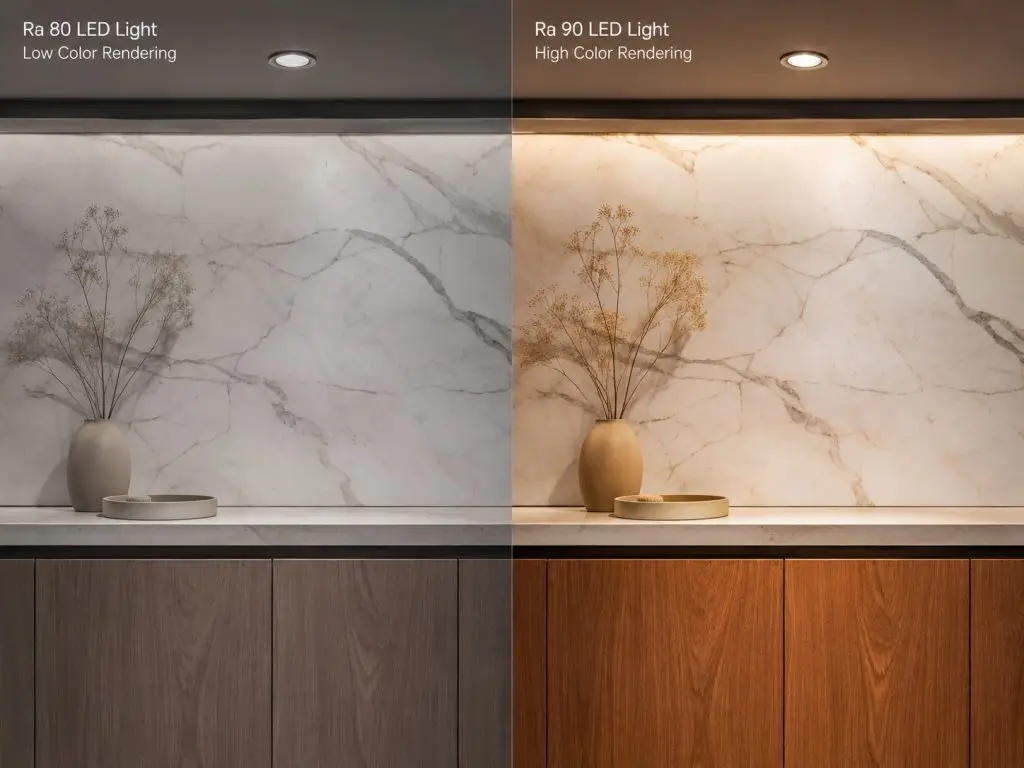
Under the low-end Ra 80 chips provided, the high-grade natural marble wall claddings appeared muted and gray. The custom wood veneers lost their warm undertones, resulting in a finish that fell significantly short of the project’s marketing renderings. The design team requested an immediate re-evaluation of the lighting package. Following rigorous on-site mockup testing, the developer decided to replace the fixtures across all primary display areas and guest suites, upgrading to custom arrays utilizing chips specified at Ra≥90 and a red saturation index of R9≥80.

A split-screen photographic comparison of premium marble and wood surfaces under a standard Ra 80 LED light showing a gray cast versus a high CRI Ra 90 LED chip revealing true-to-life vibrant colors.

On-Site Takeaway: For luxury retail, hospitality, and high-end residential spaces, color rendering indexes are non-negotiable architectural requirements. Standard engineering fixtures prioritize lumens over spectral completeness to save costs. Locking in high-performance spectrum parameters during the initial scheduling phase is critical to avoiding secondary installation labor costs overseas.

2. Material Degradation in Humid Climates: The Cost of Substituted Diffusers

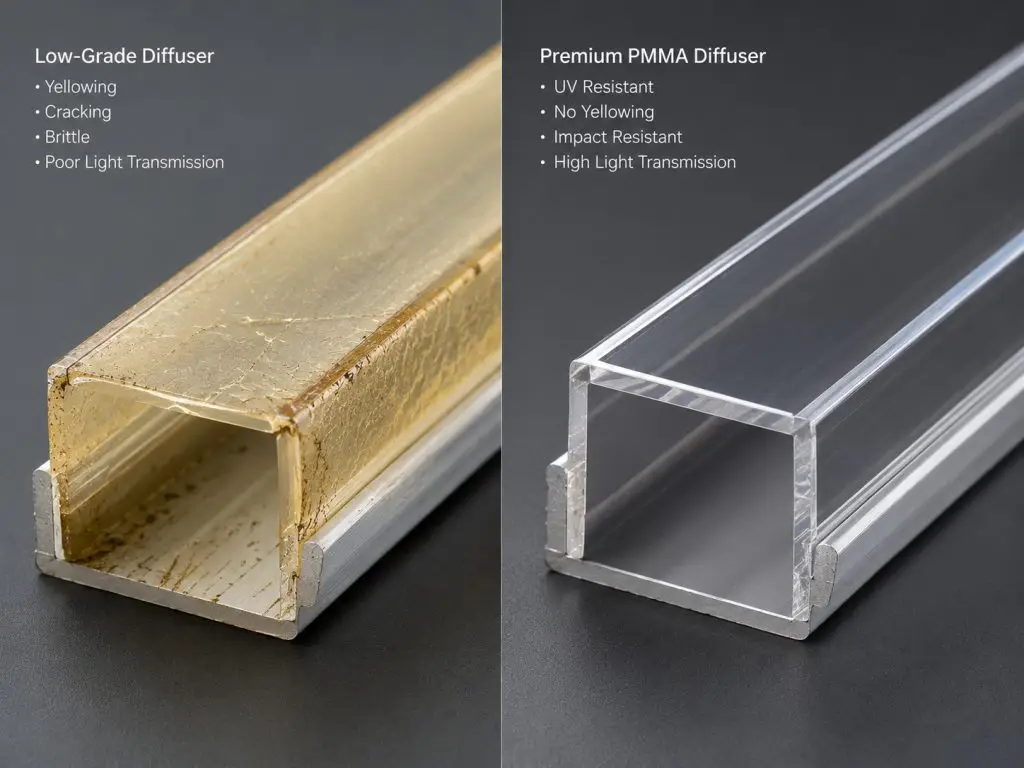
A regional developer managing coastal residential builds recently approached our team to engineer a complete lighting replacement package for a two-year-old multi-family complex. The linear LED diffusers throughout the public corridors had severely yellowed and embrittled, resulting in multiple tenant complaints.

While the site team initially assumed they had received a defective batch of acrylic, we subsequently commissioned a third-party material testing agency to analyze the degraded polymers. The results revealed a standard industry compromise: the factory had substituted the specified PMMA (Acrylic) with a cheap, non-UV-stabilized plastic blend to secure a low-bid contract.

Low-tier plastics lack the molecular stability required to withstand the continuous thermal output of high-power LED boards paired with external UV exposure. Within 18 to 24 months, these materials undergo accelerated photo-oxidation, turning brittle and yellow.

A side-by-side close-up product photograph displaying a yellowed, cracked low-grade plastic LED diffuser on the left and a crystal-clear premium PMMA acrylic diffuser on the right after heat exposure.

Material Selection Standard: For bulk export contracts—particularly into high-UV or high-humidity regions like the Middle East or coastal Australia—procurement specifications must explicitly mandate PMMA or high-grade Polycarbonate (PC) for all optical extrusions. PMMA maintains a 92% light transmittance rating over time. For high-volume freight safety, an intermediate alternative like MS polymer can balance impact resistance and surface hardness, but baseline PVC or low-end plastics should be strictly banned from commercial specifications.

3. Compliance and Customs Holds: The Regulatory Risk of Uncertified Drivers

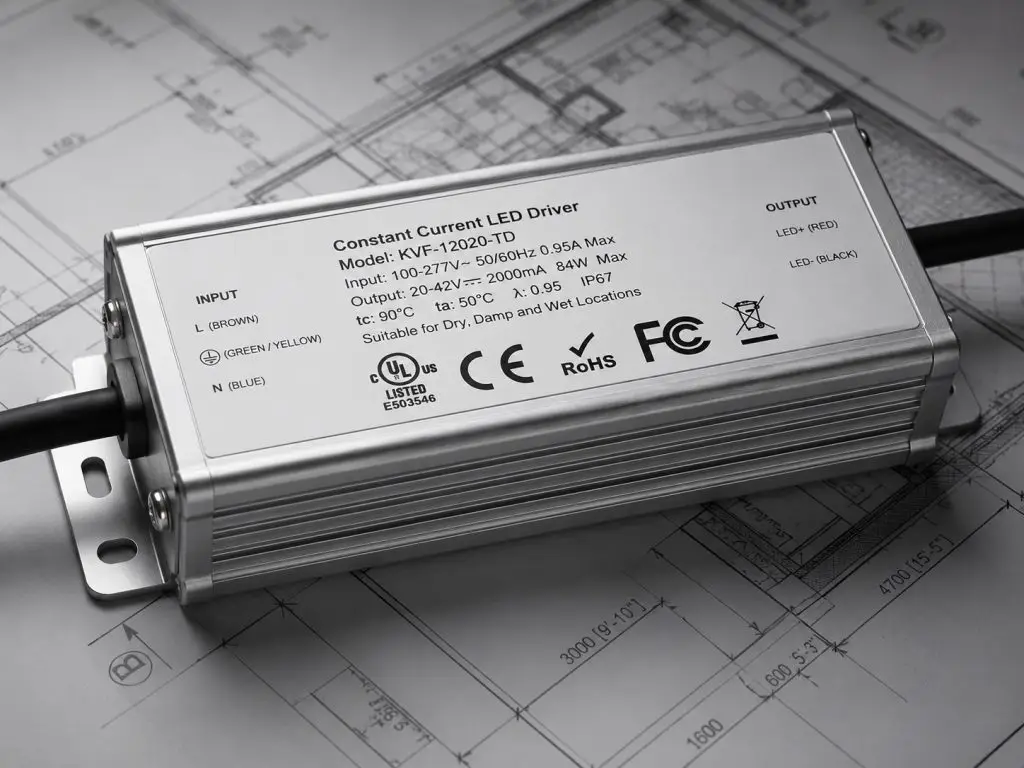
This operational failure stems from a lack of supply chain auditing regarding international customs regulations. During a multi-family residential project in North America, the design required an advanced dimming infrastructure, utilizing 0-10V and DALI protocols to enable automated, 24-hour circadian rhythm control.

The system design was correct, but the procurement team compromised on the component level. To minimize total contract costs, they sourced the dimming drivers from a regional domestic factory that lacked international compliance experience, failing to verify the necessary certification marks for the destination country.

When the bulk cargo arrived at the port of entry, US Customs detained the entire container because the electronic drivers lacked valid UL certification and verified electrical safety documentation.

A close-up corporate shot of a professional isolated constant-current LED driver resting on an engineering blueprint, with a sharp focus on printed UL, CE, and RoHS compliance certification marks.

On-Site Takeaway: Every mass-production contract destined for international markets must undergo a rigorous regulatory audit before manufacturing begins. Uncertified electrical equipment is subject to immediate border seizures or severe port demurrage fines. Furthermore, local commercial building inspectors, fire marshals, and insurance underwriters will deny occupancy permits to properties utilizing unlisted fixtures, completely erasing any initial product cost savings.

4. Spatial Clashes: Plenum Depth vs. Deep-Cone Anti-Glare Architecture

The modern shift toward minimal architectural lighting has made the integration of deep-cone recessed spotlights standard practice. To achieve effective glare control and clean visual ceilings, architectural specifications regularly require fixtures with a cutoff angle of 45° or higher.

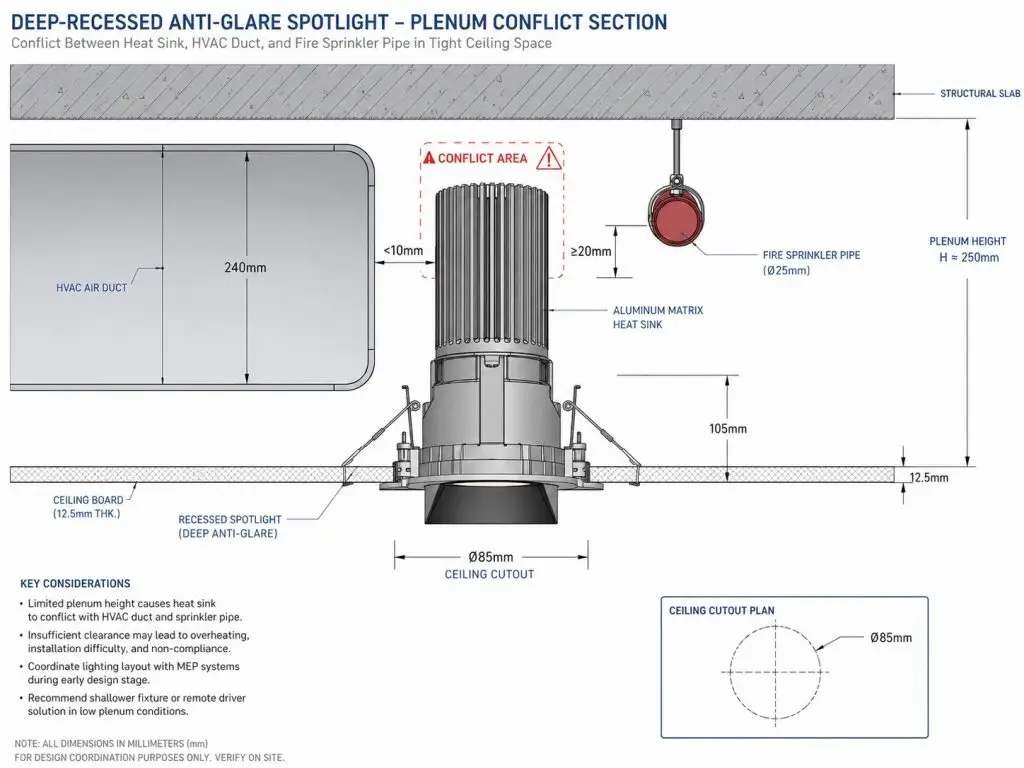
However, deep-cone anti-glare physics dictate that the fixture housing and its associated heat sink profile must be significantly taller than a standard flat panel downlight.

During the coordination phase of a recent hotel project, our engineering team successfully intercepted a major spatial conflict before mass production commenced. The contractors had pre-drilled the ceilings based on 2D layouts but overlooked the highly congested plenum space, which was packed with HVAC ductwork, fire sprinkler mains, and structural framing. Our pre-production audit revealed that the heavy aluminum matrix heat sinks of the specified deep-cone spotlights would physically collide with the fire mains, completely preventing the spring clips from engaging.

A technical 2D architectural section drawing illustrating a physical spatial conflict where a deep-recessed spotlight's aluminum heat sink clashes with an overhead HVAC duct and a red fire sprinkler pipe.

Technical Solutions & Procurement Strategy

Managing these complex physical and regulatory variables requires a supply chain partner capable of moving beyond simple order fulfillment into structured, upfront risk management.

At George Group, our engineering and manufacturing workflows were built specifically to de-risk these international contracts. Before initiating mass production from raw architectural schedules, our technical team conducts a mandatory pre-production review. We verify destination electrical codes (ensuring full UL, CE, or RoHS driver compliance), cross-check material formulations for regional climate resilience, and model plenum clearances against structural MEP (Mechanical, Electrical, Plumbing) drawings.

If a spatial clash is detected—such as a deep-cone fixture hitting a structural beam—our lines adapt through flexible manufacturing. We re-engineer the housing into an asymmetric, low-profile offset heat sink or utilize remote driver configurations to preserve the 45° anti-glare profile. Furthermore, every production batch undergoes mandatory full-load burn-in and electrical stability testing prior to crating, ensuring consistent operational reliability upon field arrival.

For international developers and construction managers, mitigating procurement risk is ultimately a matter of choosing a manufacturing partner that understands how a fixture performs not just on a balance sheet, but during hand-over inspections and over years of live operations.